Skip to content
OVOO Cell Broadcast Centre

Cell Broadcast Centre for EU-Alert on 4G and 5G

OVOO Cell Broadcast receives a warning from the national alerting authority in CAP 1.2, resolves the target area to radio cells and delivers the message to 4G, 5G NSA and 5G SA networks. Handsets in the target cells that support Cell Broadcast display the alert without an app and without a subscriber list, and broadcast time does not grow with the number of recipients.

SBc-AP to MME (3GPP TS 29.168)N50 / Namf_Communication (3GPP TS 29.518)CAP 1.2 with XMLDSig and mTLSEU-Alert (ETSI TS 102 900)
Why Cell Broadcast

Why operators move public warnings to Cell Broadcast

Public warning puts the operator between the authority that writes the message and the subscribers who must receive it. Cell Broadcast adds four properties that SMS alerts do not have.

01

Load does not grow with the audience

One request per MME or AMF for each campaign action, independent of the number of recipients, and the radio network repeats the message. An SMS alert sends one message per subscriber through the SMSC and paging.

02

The area matches the threat

The target is a list of cells or Tracking Areas inside a polygon, a circle or an administrative unit, not a whole county or region.

03

Visitors are covered

Roaming subscribers in the area receive the alert as well. The second language goes out on the additional-language channel in the same campaign.

04

The operator can show where the alert went

The network confirms where the broadcast started, and the post-event report gives the authority a record per network element.

Inside OVOO Cell Broadcast

High-level architecture

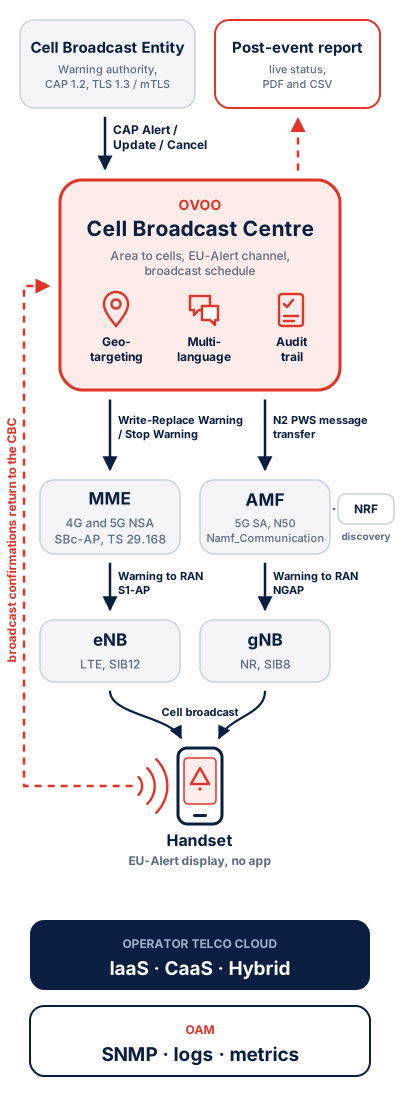
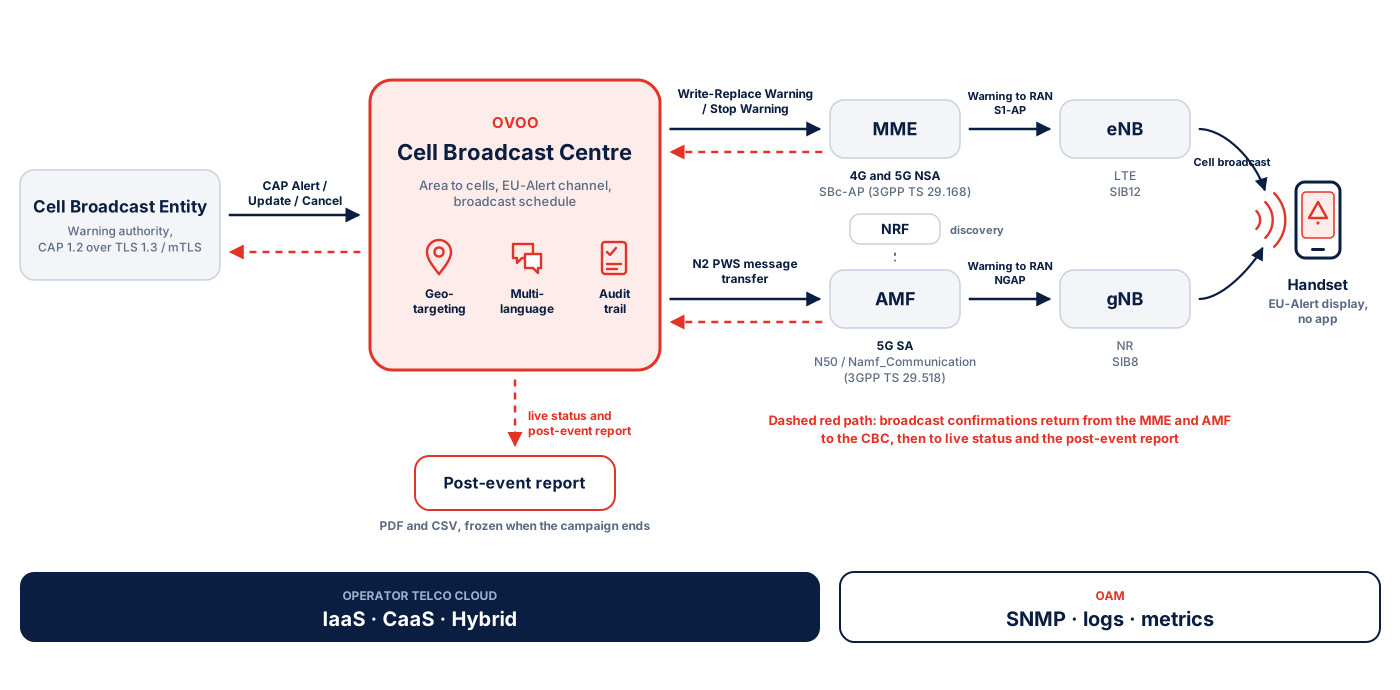
OVOO Cell Broadcast sits between the warning authority and the mobile core. It receives CAP 1.2 messages from the Cell Broadcast Entity, sends warnings to the MME over SBc-AP for 4G and 5G NSA and to the AMF over N50 for 5G SA, and collects the network confirmations into the campaign status and the post-event report. The radio network broadcasts the warning to handsets in the target cells.

OVOO Cell Broadcast Centre receives CAP 1.2 warnings and connects to MME over SBc-AP for 4G and 5G NSA and AMF over N50 for 5G SA, with broadcast confirmations feeding campaign reports
One CBC for 4G and 5G: the same warning area gives consistent targets towards the MME and the AMF.
Benefits

What the operator gains

The cards below summarise the operator's gains in business terms. Technical detail follows in the features section.

Article 110 compliance without rebuilding the network

OVOO CBC connects to the existing MME and AMF over standard 3GPP interfaces. The radio network already carries Cell Broadcast; the operator adds the CBC and the peer configuration, not new network nodes.

One CBC for 4G and 5G

One system serves 4G, 5G NSA and 5G SA. One area definition gives consistent targets on both paths, so campaigns do not need to be set up twice.

Speed without SMS signalling load

A campaign sends one request per MME or AMF instead of one SMS per subscriber. The SMSC and paging stay free for regular traffic during an emergency.

Geographic precision

Warnings target cells inside a polygon, a circle or an administrative unit. People outside the threat area are not alarmed.

No app, no opt-in

Cell Broadcast support is built into handset operating systems. The operator does not depend on app installations, location permissions or push notification services.

Fits the telco cloud and OAM

The CBC runs on the operator's telco cloud, on virtual machines or containers, and reports to the operator's monitoring, SIEM and backup. No dedicated hardware lowers the total cost of ownership.

Market

Market adaptation to 2026 rules

Article 110 of the European Electronic Communications Code (Directive (EU) 2018/1972), often called "reverse 112", requires Member States with a public warning system to ensure that providers of mobile number-based interpersonal communications services transmit public warnings to the end users concerned, from 21 June 2022. In 2026 European markets are at different stages of adapting to it: many run EU-Alert over Cell Broadcast, while others rely on location-based SMS or apps and are discussing Cell Broadcast.

ItemWhat it means for the operator
EECC Article 110(1)Warnings reach end users through mobile networks; the article is technology-neutral, and Cell Broadcast and location-based SMS both qualify (BEREC BoR (19) 255)
EU-Alert (ETSI TS 102 900)The European Cell Broadcast profile: Message Identifiers for EU-Alert channels, including Level 1 to Level 4, EU-Amber, EU-Exercise and EU-Test, with local-language and additional-language channels
3GPP TS 22.268 and TS 23.041PWS requirements and the Cell Broadcast Service, including the SBc and N50 procedures
National CAP profilesAuthorities send warnings in OASIS CAP 1.2 with a national profile; the CBC maps severity and urgency to EU-Alert channels, and the profile is set per market
Markets adding Cell BroadcastCountries that use SMS today are adding Cell Broadcast; in Poland, for example, alerts go out as SMS and the Ministry of the Interior is in talks with mobile operators about launching Cell Broadcast alongside SMS in 2026
EECC adopted (2018)
Article 110 applies (21.06.2022)
EU-Alert in operation across Member States
2026: further markets adding Cell Broadcast
Features

Features

The features are grouped by the area of work they support. Interfaces follow 3GPP, ETSI and OASIS specifications.

Targeting

  • Target by administrative unit code (for example TERYT in Poland), polygon of any shape, geodesic circle, or a union of these
  • One area definition resolved to LTE cells (ECGI) and Tracking Areas towards the MME and NR cells (NCGI) and Tracking Areas towards the AMF
  • Deduplication of cells across area elements, counts per radio technology before launch
  • Versioned import of administrative boundaries and the operator's radio data
  • Saved areas reused in later campaigns

Alerting and CAP

  • OASIS CAP 1.2 intake with a national profile: Alert, Update, Cancel
  • Mapping of CAP severity and urgency to EU-Alert Message Identifiers
  • Local-language and additional-language channels in one campaign; UCS2 for national characters, up to 15 CBS pages
  • Repetition period, number of broadcasts, start and stop; defaults for fields the CAP message leaves empty
  • Parallel campaigns with priority
  • Manual campaign launch, edit and cancel by authorised users

Delivery and monitoring

  • SBc-AP to the MME pool over multihomed SCTP (3GPP TS 29.168): Write-Replace Warning, Stop Warning, PWS Restart and Failure Indication
  • N50 to the AMF (3GPP TS 29.518): HTTP/2, TLS 1.3, OAuth2, NRF registration, direct and SCP-based communication (Model B and C)
  • Load sharing across the MME and AMF pools, retry through another node when a node does not confirm, online add and remove of nodes
  • Reload of active warnings after a RAN node restart
  • Live status per cell where the MME or AMF reports the Broadcast Completed Area List per cell, otherwise per Tracking Area

Reporting and audit

  • Post-event report frozen at campaign end: reference, CAP identifier, first and last broadcast confirmation, cells completed, failed and without confirmation, breakdown per network element
  • Reach estimate before launch and in the report (cells, sites, Tracking Areas, estimated population), labelled as an estimate with its data source
  • PDF and CSV export
  • Audit trail of user actions in the console and CLI

Operations and OAM

  • Kubernetes across two active/active sites, data replicated between sites, rolling upgrades
  • Prometheus metrics and Grafana dashboards
  • Log export to ELK and syslog to the operator's SIEM
  • SNMP traps and polling towards the operator's fault management
  • CSV export of KPIs and campaign records
  • CLI for all console functions

Security

  • TLS 1.3 and mutual TLS towards the Cell Broadcast Entity
  • XMLDSig signature verification with a rejection code for invalid messages
  • Heartbeat and acknowledgements with a reference
  • Personal user accounts and role-based access
  • Integration with the operator's PKI
Console

Modern GUI

The web console gives the alert team one place to plan, launch and review campaigns. It works in the browser, and every console function is also available from the CLI.

  • Area planning on a map: administrative units, polygons, circles and saved areas
  • Handset preview of the alert in both languages before launch
  • CAP 1.2 preview with schema validation
  • Live delivery status per network element and per cell
  • Exercise mode with the class locked after the draft is saved and exercise badges on form, map, list and report
  • Post-event report as PDF and CSV
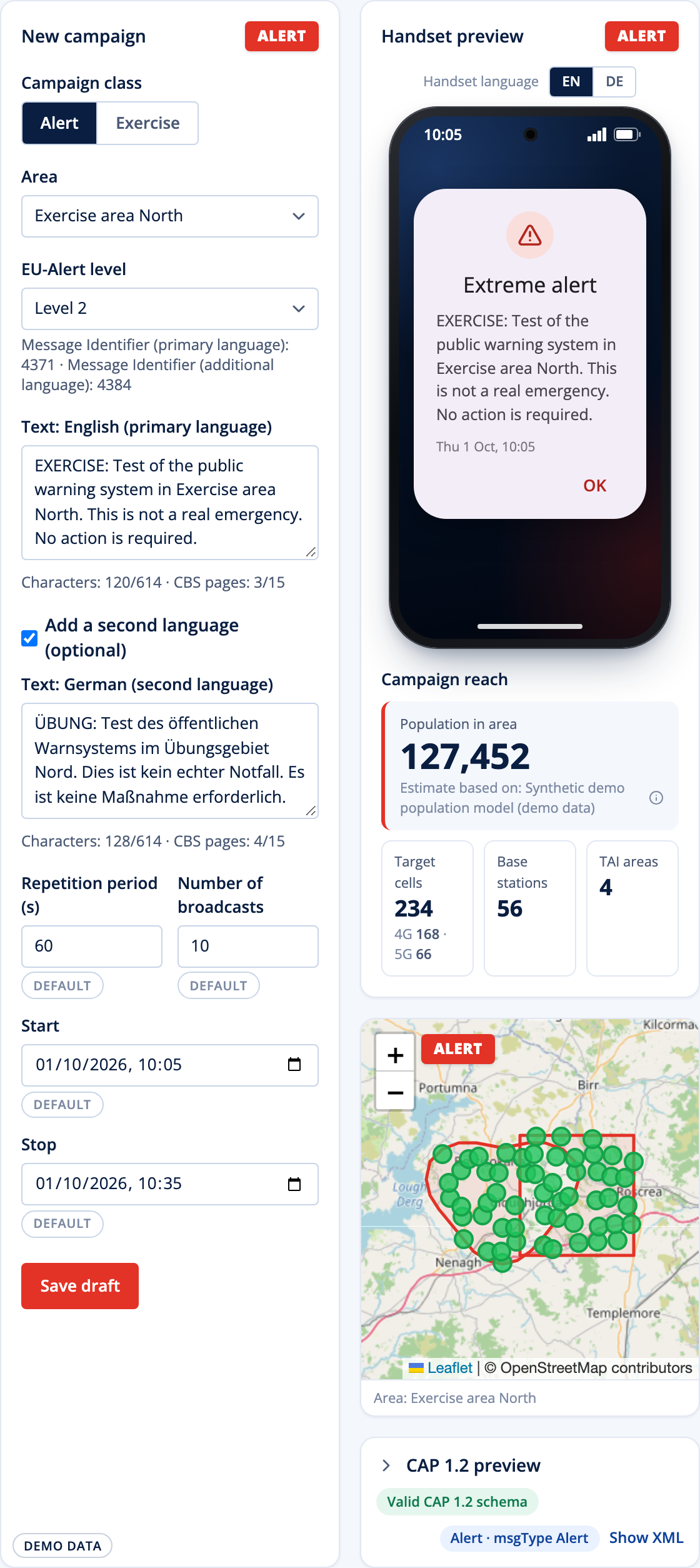
Cell Broadcast campaign form in the OVOO web console with an EU-Alert level, demo message text in two languages and a smartphone preview of the alert
Campaign form with EU-Alert level, text in two languages and a handset preview before launch.
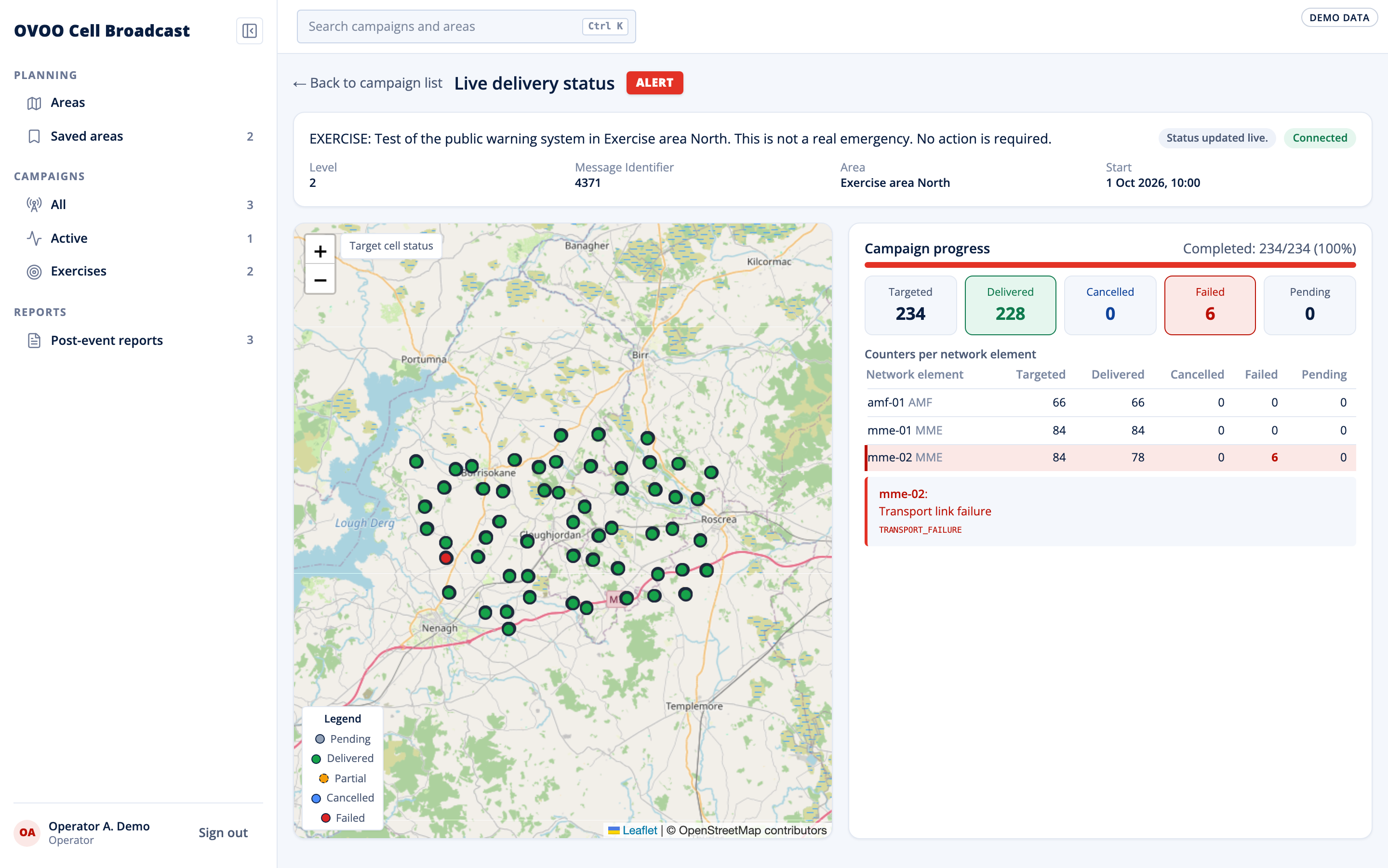
Live delivery map of a Cell Broadcast campaign in the OVOO web console with counters of completed and failed cells for MME and AMF network elements
Live delivery status per network element; a failure on one MME is shown with its cause.
Deployment

Deployment models

OVOO Cell Broadcast is built on the OVOO Messaging Gateway platform, which runs in production messaging traffic. The operator chooses the deployment model that matches its telco cloud; every model runs across two active/active sites.

IaaS (virtual machines)

  • For operators whose telco cloud standard is virtual machines, for example on OpenStack.
  • Delivered as VM images with orchestration templates; SCTP multihoming for SBc-AP over dedicated network interfaces.
  • Two active/active sites, each with its own SCTP associations to all MMEs, with campaign state replicated between sites.

CaaS (Kubernetes, containers)

  • For operators running network functions on a Kubernetes platform.
  • Delivered as container images with Helm charts; horizontal scaling and rolling upgrades.
  • Two active/active sites on separate clusters, with dedicated network attachments for SCTP agreed with the operator's cloud team.

Hybrid

  • For operators that keep databases on virtual machines and run applications in containers.
  • The database layer on VMs, the application layer in CaaS, each operated under the operator's existing procedures.
  • Active/active across two sites for both layers, with database replication between sites.
Comparison

Cell Broadcast, SMS alerts and warning apps

Many markets use SMS alerts today, and public warning apps add maps and detailed guidance. The table compares the three channels; Cell Broadcast reaches everyone in the area, and SMS and apps complement it.

PropertySMS alertPublic warning appCell Broadcast
Addressingper phone numberper app installation with location permissionper cell or Tracking Area
Reachsubscribers with a number registered in the areaonly users who installed the app and allowed locationhandsets in range that support Cell Broadcast, including roaming visitors
DependencySMSC and pagingmobile data and push notification services (APNs, FCM)cell broadcast channel of the radio network
Delivery under loadqueued, time grows with the audiencedepends on data connectivity and push deliverytime independent of the audience
Target areaset by the SMS system, often an administrative regionapp-defined zonescells inside any polygon or circle
Phone entering the area after the sendnot reachedreached if the app tracks locationreceives the active alert while the broadcast runs
Message contentshort text, limited by SMS lengthrich content: maps, links, images, guidanceup to 15 CBS pages (about 600 characters with national diacritics in UCS2)
Roaming visitorsseparate SMS in another languageonly if they install the appsecond language on the additional-language channel, same campaign
Silent modenot bypasseddepends on app and OS settingsalert tone plays in silent mode on most handsets
User opt-outnot applicableuninstall or disable notificationsLevel 1 cannot be switched off

A handset that is switched off, out of coverage or has Cell Broadcast channels disabled does not receive the alert.

Engagement

How an engagement runs

An engagement starts from the operator's network and the national profile, not from a generic template. The steps below take a project from the first workshop to service start.

01

Confirm the scope

Radio technologies, MME and AMF vendors and versions, NRF and SCP model, MORAN arrangements.

02

Agree the national CAP profile

Agree it with the authority: severity mapping, area codes, heartbeat, signature and error codes.

03

Define the radio data feed

Cell database export, coverage model (site point, sector or polygon), update frequency.

04

Select the deployment model

IaaS, CaaS or hybrid, two sites, network planes for SCTP.

05

Deploy, test and hand over

Deploy in the operator's lab and run interoperability tests with its MME and AMF, then production, tests with the national Cell Broadcast Entity, pilot and handover to 24/7 operations.

FAQ

Cell Broadcast FAQ

What is a Cell Broadcast Centre?

A Cell Broadcast Centre (CBC) is the network function that receives warnings from the authority and sends them to the mobile core for broadcast in selected cells. In 4G it connects to the MME over SBc; in 5G SA it acts as the CBCF and connects to the AMF over N50.

How is Cell Broadcast different from SMS alerts and warning apps?

An SMS alert goes to individual phone numbers, and delivery time grows with the number of recipients. A warning app reaches only users who installed it and allowed location, over mobile data and push notifications. Cell Broadcast sends one message per MME or AMF for each campaign action, and handsets in the selected cells that support it display the alert.

Do subscribers need an app or an opt-in?

No. Cell Broadcast support is built into the handset operating system. The highest alert level cannot be switched off; users can disable lower levels in the phone settings.

Which networks does OVOO Cell Broadcast support?

4G and 5G NSA over SBc to the MME, and 5G SA over N50 to the AMF. 2G (CBSP) and 3G (SABP) are not in scope.

Does EECC Article 110 require Cell Broadcast?

Article 110 requires warnings to reach users through mobile networks and does not prescribe one technology. Cell Broadcast in the EU-Alert profile is used by many Member States, and it does not depend on subscriber lists or app installations.

How can we run an exercise without alarming people?

Exercise campaigns use the EU-Exercise channel defined in ETSI TS 102 900 and CAP status "Exercise". The campaign class is locked after the draft is saved, and exercise reports are tagged separately. Many handsets do not display the exercise channel by default, so an exercise tests the procedure and the report rather than reach on handsets.

Where is the system installed?

In the operator's cloud or data centre, on virtual machines, Kubernetes containers or a hybrid of both, across two active/active sites. Radio data and campaign data stay inside the operator's infrastructure.

Talk to the engineers who build it

Leave your details and we will show the OVOO Cell Broadcast console on a demonstration scenario: area, campaign, exercise and post-event report.

Send request
Book a demo