What services can OVOO OCS charge?▾
OVOO OCS rates voice, data and SMS using immediate event, reserved event and session charging. It also supports roaming and IoT use cases, prepaid and postpaid accounts, monetary balances and single service or multiple service bundles.
Which online charging interfaces are supported?▾
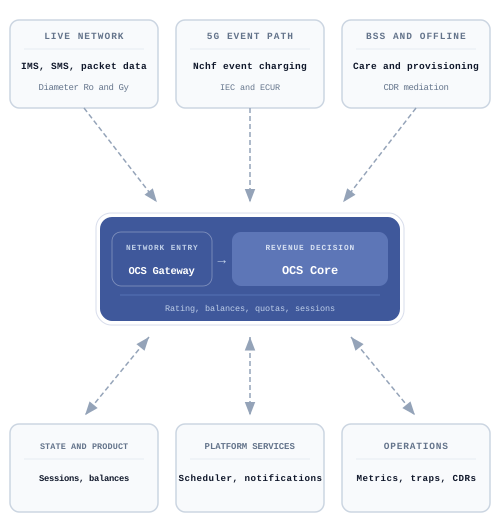
Diameter Ro supports IMS voice and event charging, while Diameter Gy supports packet data charging. HTTP Nchf supports immediate event and reserved event charging using IEC and ECUR. REST charging and provisioning interfaces plus offline CDR and SQL inputs are also available.
Can Diameter charging run beside 5G charging?▾
Yes. Diameter Ro and Gy run alongside HTTP Nchf immediate event and reserved event charging, REST and offline inputs. Operators can introduce 5G event charging while existing Diameter services remain active.
How does OVOO OCS perform at scale?▾
A two node OCS Core configuration processed 3,000 charging messages per second across four million accounts and balances, 50 million provisioning objects and 100,000 balances charged simultaneously. Average processing time was 11 ms and p99 was 45 ms.
How are incomplete or duplicate sessions handled?▾
Session controls support duplicate protection, rollback and continuation across Core nodes. Incomplete sessions can be resumed, settled from offline data or terminated when inactivity rules apply.
How does multitenancy work?▾
Providers and retailers can have scoped catalogs, charging rules, accounts, data and access roles. Traffic controls and administration for each retailer remain inside that tenant boundary.
Where can OVOO OCS be deployed?▾
Deploy OVOO OCS in private cloud, public cloud, containers or virtualized infrastructure. Supported environments include OpenStack, VMware, Kubernetes, Docker, AWS, Azure and Google Cloud. Ansible, Terraform and Helm automate delivery.
What happens first in an OCS engagement?▾
The engagement confirms services and charging modes, maps interfaces and connected systems, sizes traffic and subscribers, selects the deployment model, then defines the pilot and rollout.
Can prepaid, postpaid and hybrid services use one charging model?▾
Prepaid, postpaid and hybrid services use one connected product model for accounts, offers, rating plans, tariffs, balances and bundles. Configure the charging rules for each service and account model in the selected rollout.
Can a tariff change take effect during an active session?▾
Yes. Tariff values can be scheduled in advance, and the charging logic can split an active session at the effective time so usage before and after the change is rated with the appropriate value.
How does OVOO OCS connect to existing BSS and customer care systems?▾
REST interfaces support charging evaluation, session termination and provisioning, while offline CDR and SQL inputs cover mediated usage. The interface map defines the operations available to each connected system.
What operational visibility is available after a charging decision?▾
Operations teams can use configurable charging records, Prometheus charging and JVM metrics, SNMP traps, targeted diagnostics and GUI audit history.
How does token based unit reservation work for AI services?▾
The AI gateway reserves a token quota before the model runs. Long generations or agent loops extend the reservation mid session. When the response completes, input, output and cached tokens are rated and charged, and any unused reservation is released back to the balance. OVOO OCS is the first OCS with native support for this reservation model for AI traffic.
Can OVOO OCS charge and rate API calls?▾
Yes. API calls are rated per call, per volume, per tier or per outcome with quotas per API key, application or account. The same balances, bundles, notifications and charging records apply to API traffic, network traffic and AI tokens.